- Published on
The Rising Floor
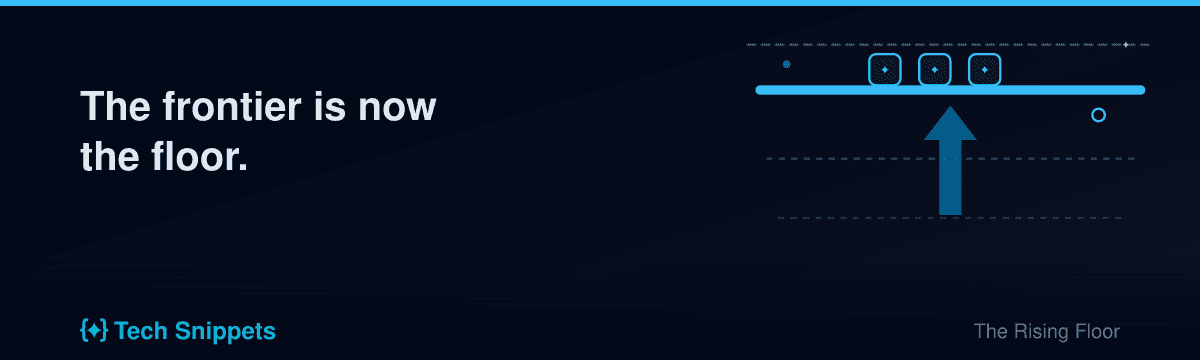
This week Alibaba previewed Qwen 3.8 — 2.4 trillion parameters, open weights, and a claim that the model is second only to Fable 5. Read that again. The number-two model in the world is going to be free to download. It landed days after Moonshot open-sourced Kimi K3, which took the top of the coding arena, and weeks after a 1.6-trillion-parameter model trained entirely on domestic chips went out under an MIT license. The frontier used to be a moat you rented access to. It's becoming a floor everyone stands on.
A floor rises. The open model you can run this quarter is roughly the closed frontier you paid for two quarters ago, and the gap between them keeps collapsing. Whatever the best model on earth can do today, the free one will do in a few months. That is wonderful news if you build on top of the model, and terrifying news if the model is the thing you're selling.
Because it reprices everything. Any product whose only advantage is "we have access to a smart model" is building on sand — the sand rises to meet it, and then swallows it. The capability you charged for becomes a checkbox the day an open model clears the bar. Everyone rents the same brain, and now half of them can download it for nothing.
So the question was never how good is your model. It's what survives the model getting better for free. The parts that compound: the context you've accumulated, the workflow people have learned to trust, the distribution you own, the taste that decides when the work is actually done. Those don't reset on release day. The model does — and each release quietly deletes whatever edge you thought the last one gave you.
There's a hardware echo underneath all this. That 1.6-trillion-parameter model trained on domestic chips means the floor is rising under the silicon too, not just the software. The compute moat everyone assumed was permanent is getting a rising floor of its own. Scarcity was the story last quarter. Abundance is the story this one.