- Published on
High-Value, Non-Recurring Touchpoints
Traditional software companies ran on the recurring 1:1 — thirty minutes with your manager, every week or two, in perpetuity. A whole leadership literature grew up around doing them well: let the IC drive the agenda, not the manager; open with one thing that went well; surface blockers early; save the back half for career growth. And they served real purposes — trust got built, problems got caught early, careers got tended. Nobody questioned the cadence itself. The standing meeting was simply what management looked like.
This year I adopted a policy that sounds extreme: zero recurring 1:1s. Not fewer — zero, including with my own manager. The hours that came back are the best hours of my week, and they go into real work: building, reviewing, writing, thinking. And no, I didn't replace them with office hours — office hours are recurring 1:1s in disguise, a standing slot waiting for obligations to fill it. The problem was never the one-on-one. It was the recurring.
The work itself is grouped into temporal, logical pods — small agile teams that form around a project, run anywhere from one to six months, and dissolve. The one recurring touchpoint that survives is the weekly pod program review, and it is relentlessly about the work: what shipped, what slipped, what's blocked — said directly, critically, in front of the people who can act on it. Status lives there, in the open, instead of fragmented across a dozen private half-hours where the same update gets performed five times.
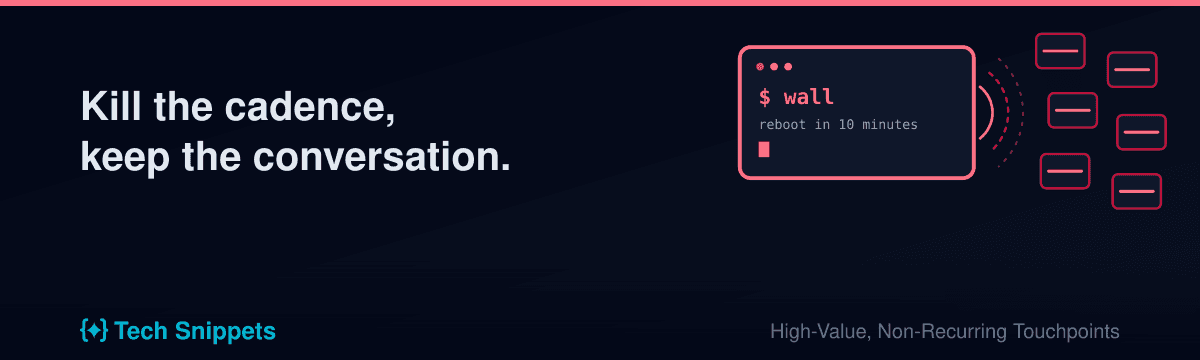
Sysadmins solved the rest of it decades ago. Linux ships a shell command called wall — write to all — that prints a message on every logged-in terminal at once: "The server will reboot in 10 minutes." "Maintenance started." In the olden days my friends and I played with it over the intranet, blasting messages onto each other's screens — half prank, half magic: one keystroke and every machine in the lab was listening. No meeting was scheduled, no invite went out. One sender, everyone informed, everyone back to work in seconds. The elegance is in what it doesn't ask for: not your time, only your attention, for exactly as long as the message deserves.
None of this means no 1:1s. It means no recurring ones. From time to time an IC books me, or I book them — fifteen minutes to an hour, sized to the topic. These conversations are high-value by construction: they exist because someone came in with a goal — a decision, a conflict, a career question — not because the calendar demanded its ritual. The career conversation still happens. It's just sharper when there's something real to decide. Broadcast often, loudly, to everyone. Be open to ad-hoc 1:1s. Then log off and get back to focused work.