- Published on
Count Your Agents
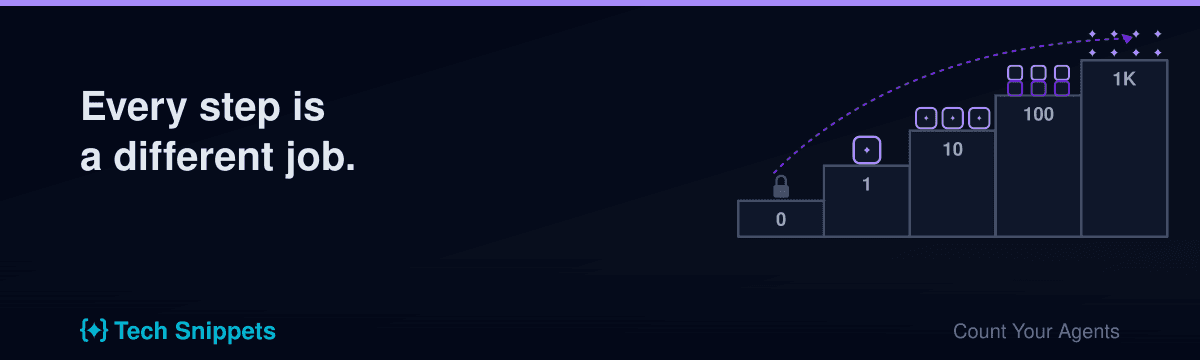
Boris Cherny — the creator of Claude Code — published a ladder of AI adoption this week, and the sharpest thing in it is the diagnostic: count the agents working for you. The steps are zero, one, ten, a hundred, a thousand agents — and each one is a different job. Here's the ladder, with the tells.
You're at step zero — gated — if the interesting models are locked behind approvals: only older, cheaper ones are blessed, every request crawls through a latency-adding gateway, and there's nowhere sanctioned to run AI-written code. Work here is copy-paste: engineers ferry snippets between the browser chat IT allows — ChatGPT, Claude.ai, Meta AI — and an editor the model never sees. The unlock is political, not technical: find an executive owner, deploy inside the SSO, IAM, and budget guardrails that let security say yes, and argue in outcomes instead of cost-per-token.
Step one — assisted — is you plus a pair programmer: Copilot or Cursor completing in the IDE, Claude Code or Codex or Gemini CLI in a single terminal tab, one session at a time. The work is synchronous and the bottleneck is your attention — trust is low, so you sit, watch, and read nearly every line before it merges. Enjoy the first unlock, the afternoon task you now finish between meetings — then earn the next step by building a verification loop you trust: tests, lint, builds the agent runs on itself, auto mode instead of permission prompts, code review automated.
You've reached step two — parallel — when you're an orchestrator: five or ten agents at once, Claude Code sessions on separate worktrees, Codex cloud tasks, Copilot coding agents assigned to issues, Google's Jules chewing through the backlog asynchronously. Your day is juggling streams — steering prompts and reviewing final diffs instead of keystrokes, while agents check their own tests, lint, and security scans before you ever look. A backlog that took the team weeks becomes one engineer's afternoon; to climb, write the context down — code, wikis, decisions — so agents stop needing you, break the work into loops and routines, and let agents kick off agents.
Step three — supervised autonomy — announces itself when the question changes from "did you read the code?" to "what context was the model missing, and how do we fix that for next time?" You're a manager of managers over an org tree of a hundred agents: subagent hierarchies — Meta's Muse Spark ships as both lead agent and subagent — routines running maintenance continuously, watchers monitoring channels and starting work before you ask. The trap is scaling the count before the loop has earned trust; hold agent code to the human bar, encode your standards where agents read them, and graduate by automating whole domains — migrations, fuzzing, feedback remediation.
At step four — AI-native — most agents are started by other agents: hundreds to thousands run, and you steer by intent and monitor by exception. The daily work looks like a VP's: setting direction, handling escalations, tuning cost controls and model choice per class of work through the agent SDKs — Anthropic's, OpenAI's, Google's. The unlock is the quarter-long migration reduced to a workflow you kick off and check on — and the scarce skill left is knowing what to want.
So count your agents. Zero, one, ten, a hundred, a thousand — the number tells you your step, and every step is a different job. Find your number, then do the one unlock that multiplies it by ten.